
This Will Completely Change How You Decide What Kid Art to Keep
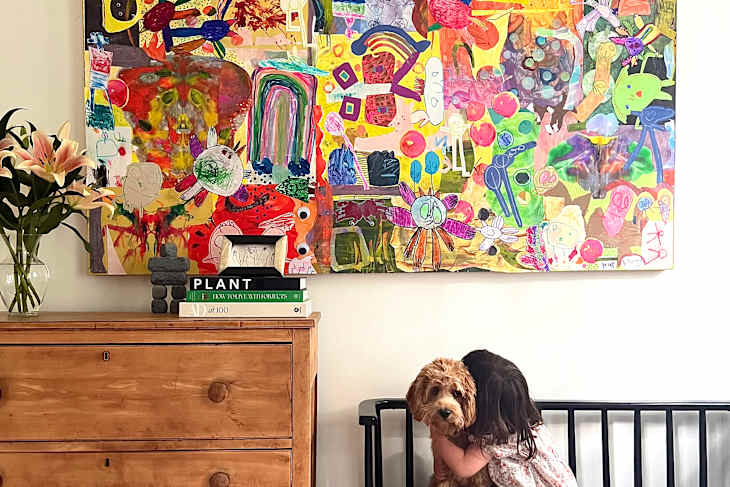
My view as I write this: a dining room wall absolutely stacked with my daughter’s taped-up artwork. While I love celebrating her latest creations, I often crave something a bit less chaotic. That’s why artist Shana Blakley’s viral “heirloom collages” caught my attention. The concept? Create one big piece — made up entirely of kids’ art — that you actually want to display.
The Virginia-based mom of a 4-year-old daughter and a 7-year-old son was inspired by the same dilemma: a wall full of taped-up art in her kids’ playroom. “We had this big, blank wall,” she says. “I thought … I have all the materials. Why can’t I make a more gallery-style art piece?” After getting buy-in from her kids, she grabbed a wood panel and started arranging, cutting, and gluing. The result: one big collage that reflects both kids’ art evolution. And the whole family loves the finished piece!
Blakley posted it on Instagram, and the idea went viral. “Parents kind of saw themselves in it,” Blakley says. Soon, she was getting commission requests from around the world (she even created an e-course that’s helped almost 900 people through the process).
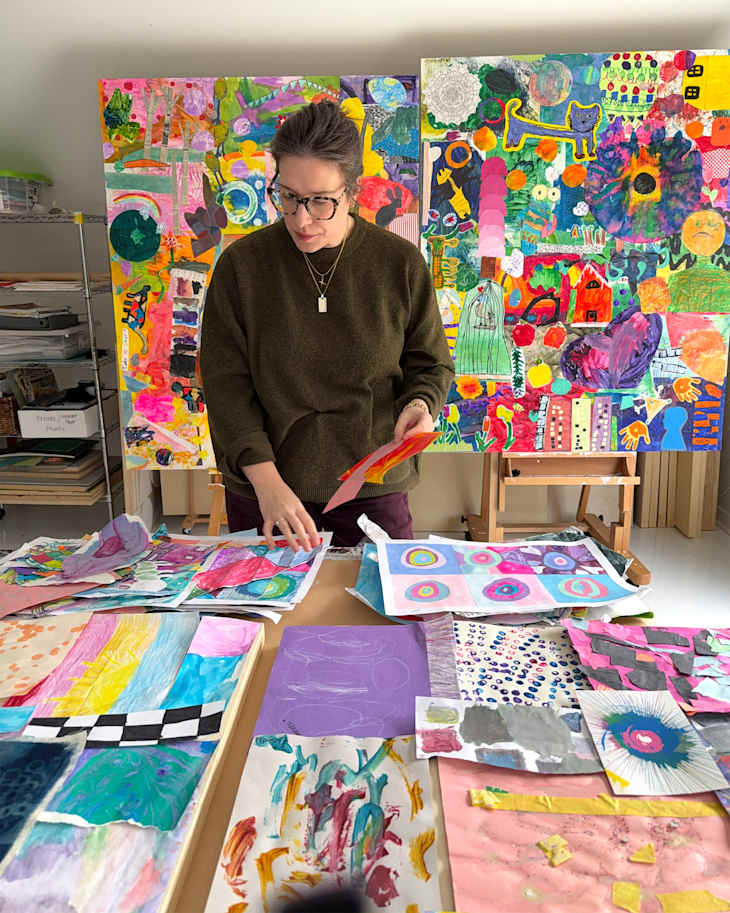
Want to turn your own mountain of kids’ art into one big collage, or just pare down the stack a little? After sorting through thousands of pieces, Shana shares her tips on what works, what doesn’t, and what’s worth tossing (maybe, if you can handle it).
Include Kids in the Process
Whether you have little kids or even adult children, it’s a good idea to let them know what you’re planning before you grab the scissors — or the trash bin. “You are cutting up or manipulating something that they’ve made,” Blakley says. “My son had some special pieces, to him, that he did not want me to use, so of course I didn’t.”
You can also get their help on placement, or, depending on their age, cutting and gluing. One of Shana’s students, a mother in Taiwan, created a collage alongside her 5-year-old daughter. “The daughter saw my viral video on Instagram. The mom took the course and they created this piece together,” Blakley says. “It’s really special to think that this experience is drawing families closer together.”
Give Keepsake Art a Home
Blakley’s favorite place to save up pieces: a lidded box at the top of her kids’ closets. It’s dark, temperature-controlled, and out of the way. “When they come home from school, if there’s something I really love, I’ll just take it immediately into their rooms … just so things aren’t left and scattered around the home and there’s one place where [the art can] live,” she says.
She recommends a box for each child so that art can be used separately or together.
Start with Sentimental Pieces
Works that only your child could create are a great place to start curating. “What I’m first drawn to when I’m looking at a body of children’s artwork is the sentimental pieces: the self-portraits, the stick figures, the progression of how the kids draw people over time,” Blakley says. “Those pieces carry so much personality and story.” Think: family scenes, drawings of your home, or even attempts at writing their name and how that changes over time.

Showcase Their (Ever-Changing) Interests
Save pieces that remind you of each sweet childhood obsession. “It’s really cool,” says Blakley, “to be able to go through and see the rainbow phases, the unicorn phases, the monster phases. And that also applies to mini-milestones, like their purple era or the first time they mastered a circle. “You can just learn so much from the marks that they make, the color choices, the strange creatures that they’re creating,” she adds.
Abstract Art = Background Gold
Color studies might not pull on the same heartstrings as family portraits, but they can be great filler when collaging. “I love the abstract pieces that kids make, so any of the big watercolor explosions, or rich patterned pieces are really good for background layers,” Blakley says.
Skip the Scribbles and Coloring Sheets
Worksheets or works in progress tend to take up space without telling a real visual story. Blakley tends to pass on printed papers and coloring sheets. Another thing she sends back to families? “Any sort of papers that you can tell were sort of scribbled on at the last seconds before dismissal.”
Avoid “Edible” Art
Blakley also steers clear of adding artwork created with edible elements, like macaroni or beans, in her heirloom collages. They tend to degrade more quickly than other pieces and can attract pests to storage boxes. This doesn’t include 3D elements, like googly eyes or pom-poms, which can add fun texture without sacrificing longevity.

Think Quality and Quantity
One of Blakley’s most commonly received questions: What is the best age to create my child’s collage? Her answer: “It’s not really about age,” she says. “If you have a good stack of work and lots of things that you’re drawn to, that would be a good time to make a collage.” You can make one that represents their entire childhood or create multiple collages representing different phases.
She recommends using a large-scale canvas — a minimum of 24”x30” — and saving up 50 to 100 pieces per collage.
If in Doubt, Trust Your Intuition
The best judge of what to keep and what to toss? You! “When you get a piece from your child … you can feel instinctively which pieces matter to you,” Blakley says. “That’s the work worth saving.”