
This “Two-Finger” Rule Changed the Way I Pick Out Watermelon Forever
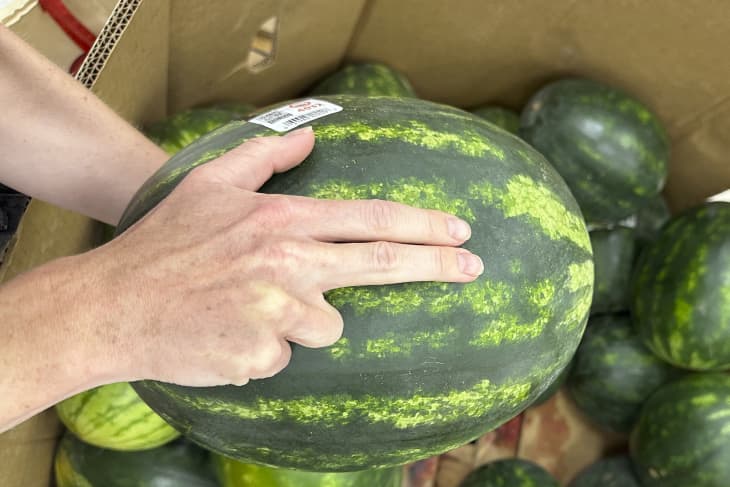
I love summer for a lot of reasons: the sunny skies, the smell of hot dogs sizzling on the grill, and, most of all, the in-season watermelon, which is sweet and refreshing as can be.
I used to pick one at random; I hoped the greenest rind meant the ripest fruit. Then last year I discovered the “two-finger” rule, which is a simple (farmer-approved!) trick that helps me choose a perfectly ripe watermelon every time. It’s made this summer sweeter than ever.
What Is the Two-Finger Rule for Watermelon?
Mackenzie, a contributor here at The Kitchn, spoke with two watermelon farmers and a few grocery store managers to unearth the rule. It’s the key to picking out a “winning melon.” (No thumping needed.)
The tip is surprisingly simple: A perfectly ripe watermelon should have dark green stripes about the width of two fingers. To check, hold two fingers together lengthwise and place them on the rind. If the darker green area between the pale stripes fits both fingers, you’ve likely found a winner. It’s an easy way to take the guesswork out of picking the perfect melon.

What Makes the “Two-Finger” Rule Perfect for Picking Ripe Watermelon
I was hesitant about this rule at first. I’ve heard several watermelon-picking tips over the years (look for a yellow base, check for ripeness by smell), but the “two-finger” rule wasn’t one of them. The tip works because as the watermelon ripens and gets larger, the stripes tend to separate, and the space between them widens. (My own farmer friend, Kim, confirmed this last fall when I asked her how to pick out the best apples.)
“You want there to be at least two fingers’ worth of space between the strips so you know it’s ready. Any smaller one isn’t ripe enough,” according to Kim.
To thoroughly test this rule, I went to my local grocery store and headed straight toward the watermelon bin. I grabbed two melons: one that followed the two-finger rule and another that only had about one finger’s worth of space. When I got back to the office, I cut them up in our studio kitchen.
The insides looked pretty similar (both fleshy and pinkish-red) so I was a bit skeptical there’d be much of a difference in flavor. That all changed when I took a bite.
I started with one-finger watermelon. Although it wasn’t bad, it tasted more like water than melon; there was hardly any sweetness. The two-finger watermelon was just wonderful — juicy, sweet, with a great bite (the kind that feels satisfying to crunch your teeth into). It was the ideal watermelon! I even had juice running down my arms.
Do you have a foolproof tip for picking out produce? Tell us about it in the comments below.
The Weekly Checkout
Sign up for The Weekly Checkout to get the most up-to-date grocery news, tips, and highlights.
This post originally appeared on The Kitchn. See it there: The "Two-Finger" Rule That Changed the Way I Pick Out Watermelon Forever