
How to Embrace Montessori-Inspired Toy Rotation Without It Becoming Your Full-Time Job
As parents, there’s a lot we say we’ll never do. I’ll never allow an iPad at dinner. I’ll never let my kids sleep in my bed. And also very likely, toys will never take over my house.
The latter can be a constant struggle — it certainly is for me and my two preschool-age daughters. One coping strategy can be constant cleanup, which feels chaotic and exhausting. Another is donating everything and calling it a day. Neither is realistic.
Instead, parents might consider a more curated, Montessori-inspired approach. Developed by Italian physician and educator Dr. Maria Montessori more than a century ago, Montessori education features mixed-age classrooms in school settings alongside hands-on exploration and activities meant to foster independence.
In Montessori-style settings, toys are routinely rotated. I was intrigued by this approach yet also overwhelmed by the thought of regularly reorganizing hundreds of toys and activities in my house, so I spoke to two child education experts and a mom who swears by Montessori rotation to understand the best way families can implement this method.
What Are Montessori Toys?
While Montessori-style toys aren’t official items put out by the American Montessori Society, many playthings are inspired by their methods.
Typically they’re “made from natural materials and mirror real world experiences,” says Michaela LeRoy, a CDA-certified education and development specialist at The Haven Collection, a childcare, co-working, and wellness space that utilizes a Montessori-based curriculum.
You don’t need exclusively Montessori-style toys to implement toy rotation, but they can complement it nicely. That’s because they usually promote concentration, problem solving skills, and natural curiosity. “Children become active learners in play rather than being directed by a toy,” says LeRoy. “Montessori-style toys are typically simple, purposeful, and rooted in real-life skill development.”

What Is Montessori Toy Rotation?
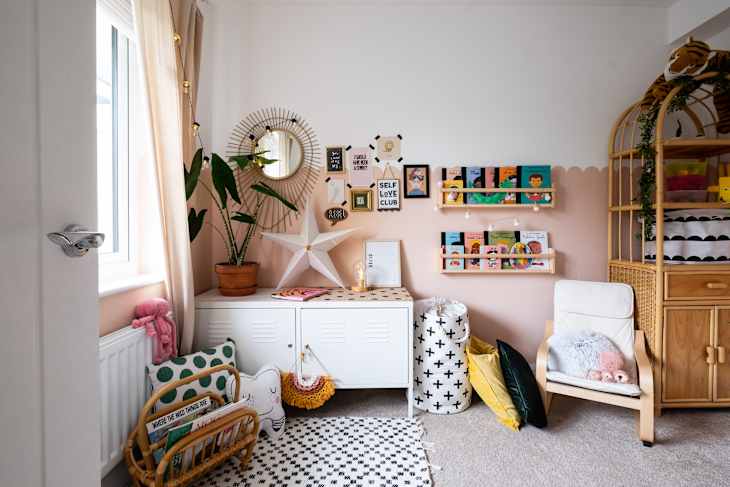
A hallmark of Montessori-style play is toy rotation. This is where only a few toys — Montessori-style or regular — are kept out at any given time, usually on low, open shelves. The rest are stored away out of sight. There’s no official “schedule” for when you must switch out toys, but it can be as often as weekly. This concept is generally introduced to children when they are around 6 months old, and kept in practice in the preschool years, often up to ages five or six.
“Toy rotation is a classic Montessori technique,” says Rachel Coley, MS, OT/L, a pediatric occupational therapist, mom of three, and the resident child development expert at Lovevery, a subscription toy company centered on Montessori-inspired play. “With fewer options in reach, a child will engage more meaningfully with each toy, playing in a deeper way and spending more time exploring each item,” she says.
LeRoy adds, “When children are exposed to too many toys at once, it can feel overstimulating, and they may move quickly from one item to another without fully engaging.”
Rotating toys, books, and activities also helps children to care for themselves and their surroundings. “It allows for children to get deeper into longer stretches of play. Seeing that each item has a place can help encourage children to clean up after themselves in a way that welcomes order,” Coley says.
Less mess? Sign me up. Which is probably why some parents swear by it.
Ashley St. Pierre Martin, a mom living in California, has been using Montessori principles with her 4-year-old son since he was a baby.
“We have a dedicated learning area in a shared space where we have a mat, low shelves with the lessons, and access to art materials,” St. Pierre Martin says. “As he has grown, we’ve adapted and rotated materials to match his developmental stage, expanding with language, math, and some world materials.”
The benefits, she says, are truly worth it.
“My child can sit and work with materials for extended periods, make choices confidently, and enjoy completing lessons at his own pace,” she says. “He understands where things live and how to put them back. He’s treating his non-Montessori toys with this level of care, as well, making sure the items go where they belong.”

How to Try Montessori Toy Rotation at Home
If you’re Montessori-curious, Coley recommends starting with anywhere from a few to a dozen play things on a low shelf wherever your child plays with their toys. (This may mean storing the toys you won’t use in a large bin or container away from the play area.)
“Over the next week or so, pay attention to the objects that attract your child the most and how they like to play with them. Your child’s fresh interest in an old toy might surprise you,” she says.
Rotation should then occur naturally. “Rotate toys when it feels right, no more than once a week and potentially every few weeks,” Coley explains. “Some weeks you might change just a couple of toys and others a few more depending on how your child is playing and showing interest.”
According to the Global Montessori Network, you can add toys that introduce a new skill your child has shown interest in and include a mix of toys, books, and artistic activities.
How to Try Toy “Micro-rotation”
And rest assured, there’s no need to overhaul your entire house or replace everything with new Montessori-style stuff. For an even more pared-down approach, Coley advises parents to start with a small “micro-rotation” where you pick one small area — a single shelf or surface, for example — and reduce visual clutter and limit toy choices to just four to six items.
If it still feels overwhelming to choose what should stay out, you can choose your four to six items from one category, such as cars, dolls, or art supplies. Everything else is stored away.
“Try it for two weeks and see if your child asks for the missing toys or plays more deeply without them,” Coley said. And if they do miss them, there’s no harm in giving toys back.
And finally, give yourself grace. You don’t need a degree or a meticulous playroom.
“We don’t always manage to keep the shelves minimal. We also want our home to feel relaxed, so we’re much more flexible with how we maintain the space,” St. Pierre Martin says. “You don’t need a classroom at home. The idea of accessibility, order, and thoughtful rotation is what matters.”
Find practical ways to tweak your habits and make every day a little easier and joy-filled with Routines, Simplified! This content was presented by a sponsor; it was created independently by our editorial team.