
The Playroom Reset: How to Organize Your Playroom for Better Play (and Less Chaos!)
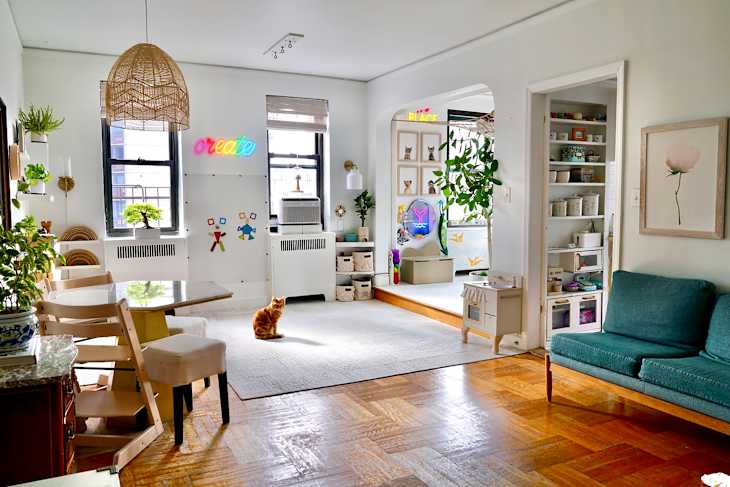
During a recent home tour, people couldn’t believe how I kept my small one-bedroom apartment so neat and organized with three kids. The truth is, I cleaned up before the tour. But the real secret is that I’ve developed systems that make keeping playrooms tidy surprisingly quick and easy.
But having a tidy playroom wasn’t my goal when I set up those systems — I just wanted my toddler to play by himself for more than two minutes at a time.
Back then, all his toys lived in giant bins — bottomless pits where everything was tossed without thought. Cleanup was easy: I’d just throw everything back in. The problem? My son’s play mirrored cleanup, but in reverse: He’d mindlessly dump everything out, and playtime would end there.

We were stuck in an endless loop of frustration and boredom.
Everything changed when I discovered the power of toy rotation, play zones, and the principle that less is more. Giving toys intentional homes and putting fewer things out at once made our space feel calmer, and my son started playing longer and more creatively. It’s still easy to clean, but now it’s inviting and sparks deeper engagement.
Here’s how you can reset your playroom today:
Step 1: Set Up a Toy Rotation System

The first — and most important — step to creating a peaceful, engaging playroom is setting up a toy rotation system that reduces the number of toys out at any given time.
Think of it like your work desk: a clear, organized space helps you focus, while a cluttered desk piled with paperwork creates stress and decision fatigue. For kids, play is their job — and a calm, organized play space helps them focus, explore, and create just like a well-organized desk helps you work.
Here’s how to do it:
- Sort toys into categories like imaginative play (play kitchen, dress-up clothes, doctor kit), small-world play (dollhouse, animal figurines), music toys, building toys (blocks, Legos), and themed toys.
- If your child has a particular passion, like dinosaurs, dolls, or cars — and the collection is large enough — giving that theme its own category may make sense. For example, my kids love cars, so we have a separate bin just for wooden cars, Matchbox cars, planes, and other vehicles.
- Pick a few toys from each category to keep out and place them in dedicated bins — one bin per category works best. These bins will become part of your Toy Hub (more about that coming up).
- Store out-of-rotation toys out of sight. Put the remaining toys away, keeping them separated by category. (You can even store sets separately with these zipper mesh bags). I’ve stored toys under my bed, in my kitchen, and at the top of my closet; really anywhere out of sight will work.
Step 2: Create Play Zones with Flow in Mind
Once you’ve set up your toy rotation, the next step is to create play zones — purposeful areas that support different types of play.
Play zones help kids understand what to do and where to start when they enter a room. Instead of feeling overwhelmed by scattered toys, zones enable them to find what they need easily and without asking for help. If they want to build, they can go to the building zone, where blocks, LEGO, and Magna-Tiles are all in one place — no digging through bins or depending on a parent for guidance.
A zone can be as simple as a wall, a nook, or a designated corner — just enough space to create a clear boundary for a particular type of play.

When designing your zones, consider how they connect and flow together. Pairing zones that complement each other encourages richer, more connected play. For example, I placed our dress-up station near the movement area because my kids love to dress up as characters and chase each other around. Similarly, I set up small-world play near the block area since blocks often become houses, roads, or props for imaginary scenes.

Just as important as pairing complementary zones is leaving intentional open floor space. Open space creates flexibility — giving kids room to spread out Magna-Tiles, build train tracks, or set up elaborate small-world scenes. It also invites movement, whether it’s racing cars, practicing somersaults, or dancing to their favorite songs.

By combining thoughtful zones with purposeful open space, your playroom becomes more than just organized — it becomes a place that invites creativity, independence, and deep, engaged play.
Here are some easy, effective play zones to consider:
- Toy Hub: Organized bins for easy access to toys.
- Imaginative Play Wall: A dress-up station with hooks and a mirror.
- Building & Construction Zone: A table or floor mat for Legos and blocks.
- Cozy Reading Nook: A small shelf with forward-facing books and soft cushions.
- Creative Corner: A low table with art supplies, paper, and an easel.
- Movement & Active Play Area: play couch, swing, balance beam, or soft mats for tumbling.
- And don’t forget zones tailored to your child’s interests. A Lego zone, dinosaur zone, or makeup vanity station can create excitement and encourage independent play.
By organizing your space into purposeful play zones, you create a setup that invites kids to make their own choices, play independently, and, most importantly, lose themselves in deep, focused play where time seems to disappear.
Step 3: Eliminate Visual Clutter
Less is more when it comes to creating a calm, inviting playroom. Reducing visual clutter can help kids focus, inspire more intentional play, and make the space feel peaceful and under control — for both kids and parents.
Here’s how to simplify your space while still keeping toys accessible:
- Store toys in neat, concealed bins. Don’t worry, kids will remember what’s inside. Thoughtfully reducing what’s on display helps children focus and choose what they want to play with without feeling overwhelmed. And you’ll love how neat it all looks.
- Don’t feel obligated to keep every piece from a toy set. If your blocks can double as a dinosaur landscape, you can skip the bulky plastic rock that came with the dino set. Curating your toy collection this way makes storage easier and encourages creative play.
- Stash eyesores out of sight. That bright orange race track your child loves, but you despise? Keep it in a closet and pull it out when they ask. Removing loud or clunky toys from view can instantly make a space feel calmer — and your child’s favorite toys will still get plenty of love.
- Display toys you enjoy looking at. Beautiful blocks, wooden toys, or play silks can double as decor, adding warmth and personality to the room. And if you’re like me, why not decorate with toys themselves? (I turned our notch blocks into a face — can you see it?)

A playroom free of visual clutter is easier to keep tidy and creates a calm, inviting environment where kids — and parents — can breathe easier and play more fully.
More Than Just Tidy: Creating a Space That Supports Both Kids and Parents Alike
A well-organized playroom doesn’t just look nice; it also creates a calmer environment, reduces overwhelm, and helps kids play longer with fewer tantrums and less frustration.
But more importantly, it shapes how children engage with the world — how they explore, create, and connect. When play feels inviting and accessible, kids are free to follow their curiosity, build resilience, and develop independence.
For parents, it’s a powerful shift, too — one that invites more peace into the home and offers a sense of support, like a quiet helping hand in the background.
In a time when so many of us are raising children without the village we desperately need, a well-designed play space can help step in — giving kids the freedom to thrive and parents the gift of a little more breathing room.