
What Does “GREENGUARD Gold Certified” on Kid Products Actually Mean?
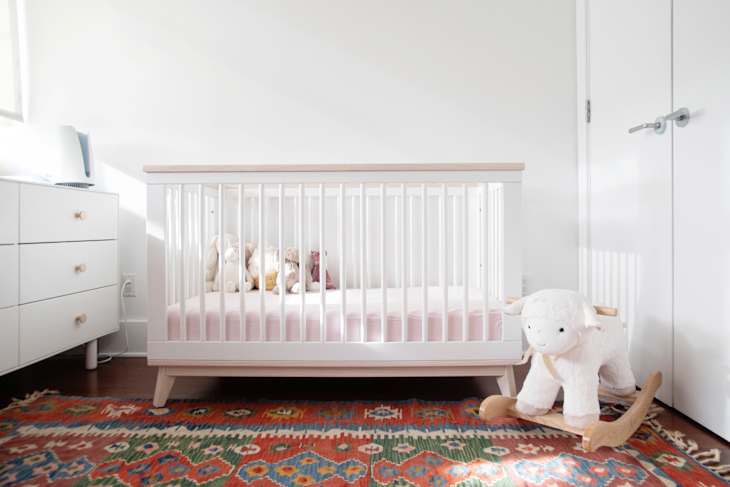
If you’ve been buying products for a nursery or kids’ room, you’ve probably seen the GREENGUARD Gold certification advertised. But you may have wondered what it actually means. Read on to learn more about what GREENGUARD is, who does the certifying, and which products you can check for the certification.
What Are Volatile Organic Compounds (VOCs)?
“GREENGUARD Gold certified” means that a product has been lab-tested by UL Solutions, a third-party company that certifies that a product emits a very low amount of volatile organic compounds (VOCs) into the air.
According to the Environmental Protection Agency, VOCs are a class of carbon-based chemicals that are “emitted as gases” at room temperature, and they exist in a number of household products, such as paint, wood preservatives, adhesives, cleaners, air fresheners, aerosol sprays, dry-cleaned clothing, and stored fuels. Furniture and home furnishings (like upholstery, curtains, carpets, and composite wood items) also off-gas VOCs — more when they’re new, less as time passes, per the American Lung Association.
There’s a lot we still don’t know about VOC exposure during childhood, but we do know that reasonably lowering kids’ exposure to VOCs is a good idea. The EPA states that the level of some harmful chemicals is two to five times higher indoors than outdoors. And babies and children are also more susceptible to indoor air pollution, says Elizabeth Cilenti, MD, MPH, a board-certified doctor in pediatrics and internal medicine at Northern Virginia Family Practice Associates. “Children still have developing and maturing lungs. [They] also breathe faster and breathe in and out more air relative to their body weight than adults.”
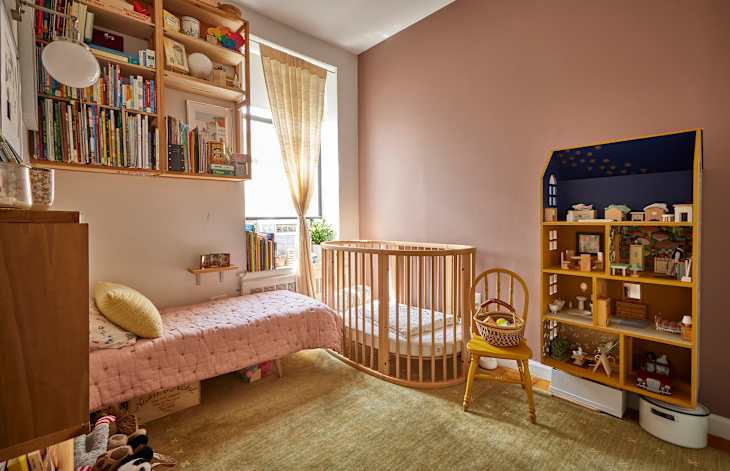
How Do Products Get GREENGUARD and GREENGUARD Gold Certified?
According to UL Solutions, the GREENGUARD testing process involves placing a product in a sealed stainless steel chamber and measuring its off-gassing for between one day and two weeks, until it reaches a steady emissions rate. While products need to emit fewer than 500 μg/m³ total VOCs for GREENGUARD certification, they must have fewer than 220 μg/m³ for GREENGUARD Gold. (If you want to get down to the technical details, this sheet lists the chemical compounds and parts per million of each allowed for GREENGUARD and GREENGUARD Gold certification.)
There are a number of ways manufacturers can create products that earn this certification, says Lyndsey Darrow, PhD, an epidemiologist with the University of Nevada at Reno. They can avoid using products known to contain VOCs, such as certain types of paints, varnishes, and adhesives. Some manufacturers allow products to off-gas for weeks or months. Or they can encapsulate the VOC-releasing material with other materials that don’t emit a high volume of VOCs, such as plastic laminate or water-based polyurethane.
As you can imagine, making a product that meets these standards can also be more expensive, and the certification process itself costs manufacturers money. They typically pass that cost onto consumers, so GREENGUARD Gold products may have higher price tags than the alternative.
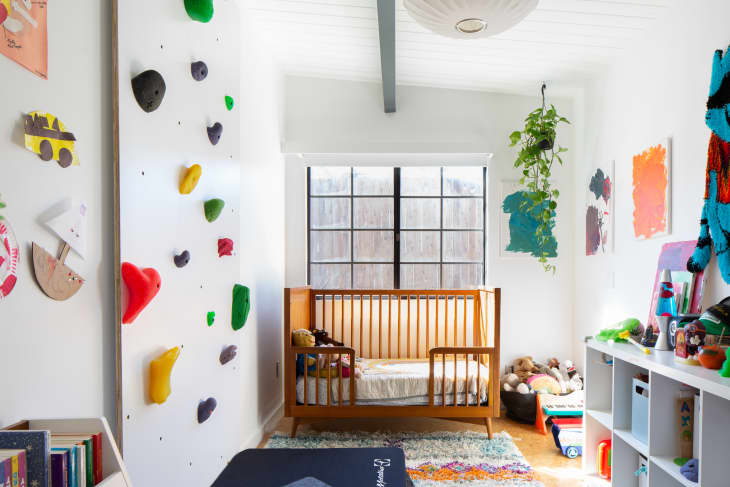
What Doesn’t the GREENGUARD or GREENGUARD Gold Certification Test For?
GREENGUARD certification does not indicate whether the ingredients are organic or sustainable, despite the “green” in its name. It also does not test for nonorganic substances like lead or mercury.
Essentially, looking for a GREENGUARD or GREENGUARD Gold certification is a good tool to help you find products that have low VOCs. However, it’s not an all-encompassing label, nor is it the only way to protect children from potentially harmful chemicals.

If You’re Concerned, How Should You Prioritize the GREENGUARD Gold Certification?
You’ll see GREENGUARD Gold labels on mattresses, furniture, flooring, car seats, strollers, high chairs, activity centers, and more. Dr. Cilenti has advice for how to prioritize this: “What are they exposed to the most? So particularly bedroom furniture, mattresses, places where kids sleep and spend a lot of time.”
Amanda Furr, MD, chief medical officer at Zarminali Pediatrics in Illinois and a mother of four, advises parents and caregivers to take a reasonable approach. “You can’t eliminate every source of VOCs, and low levels are not proven to be harmful and are often natural,” she says. “Focus on the places where your child spends the most time sleeping and breathing, prioritize the first year of life when vulnerability is highest, and make changes incrementally, as things need to be replaced anyway.”
When shopping for noncertified products, “look for what it is made of and how it is manufactured,” says Dr. Furr. “Solid wood would have less risk of VOCs than manufactured products like particleboard. Look for water-based finishes on furniture products. Many companies will list or advertise on their websites the type of materials they use, especially if they are focused on higher standards, even if they are not officially certified.”
Whether or not you buy a product with a GREENGUARD Gold certification, remember that VOCs dissipate over time. “If something is brand-new directly out of the package, even just letting it air out in a place where the child isn’t spending time for a few days can help to reduce that VOC exposure,” says Dr. Cilenti. Ventilating a space and using air purifiers with HEPA filters and carbon filters should also reduce the VOCs in a room, all three of our experts say.