
What Parents Get Wrong About the First Day of School, According to Teachers
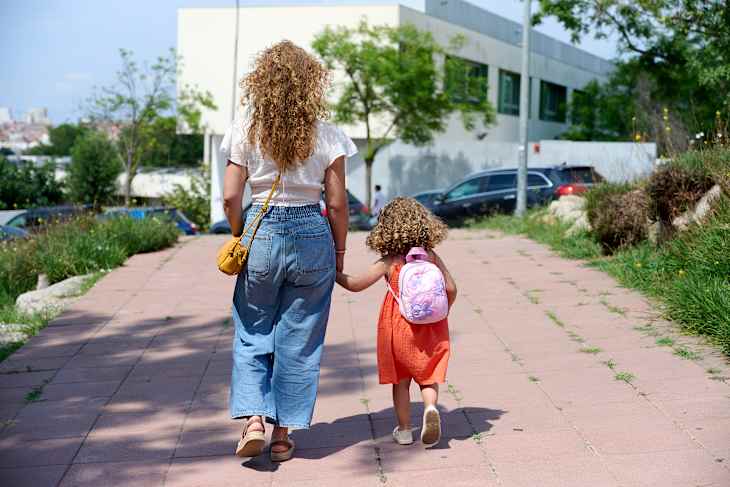
With the start of the school year approaching, many parents are scrambling to get their little learners ready for the first day. Whether they consult the school website, their child’s pediatrician, or social media to prepare, they are undoubtedly hoping that they help make the big day an A+ for their kiddos.
And just how well are they doing? We spoke to teachers to find out what grade parents would get for preparing their kids. While most get a passing grade, there are definitely things caregivers could be doing better.
1. Underestimating the preparation your kid requires.
“The biggest mistake I see is parents underestimating how much preparation their child needs, especially for younger students or those starting at a new school,” Christine Beavers, PT, DPT, tells Cubby. As a school-based pediatric physical therapist in New York City, she has seen what makes the difference between a smooth transition and a stressful one.
Beavers is a proponent for practice runs and visual guides and emphasizes the importance of parents considering the physical demands of the school day. For example, will your child need to climb stairs between classes while wearing a heavy backpack, walk between buildings, and/or navigate crowded hallways?
“The key is communicating with school staff early to understand expectations, then either practicing these skills at home or adapting supplies to match your child’s current abilities,” she says. “Sometimes that means starting with an easy-open lunch bag instead of a complicated Thermos, or choosing elastic-waist pants instead of buttons and zippers.”
“If your child needs additional support developing these independence skills, consider working with an occupational or physical therapist before the school year begins,” Beavers continues. “It’s much easier to build confidence at home than to troubleshoot challenges once the school routine is already underway.”
2. Focusing too much on school stuff and not enough on feeling safe and ready.
Educators and administrators agree that instead of prioritizing what’s inside their kids’ pencil case, parents should make sure their social-emotional tool kit is full.
“We focus so much on the backpack and the lunch box, but often skip the social stories, practice runs, or visuals that help kids, especially neurodivergent ones, feel safe and ready,” says Danielle Damico, BCBA, executive director at Spiritos School in Virginia. “Taking time to prepare them emotionally can make the first day of school less overwhelming and set the tone for a smoother transition.”
Damico tries to keep things simple, fun, and visual in the weeks leading up to school and will even make short picture books for her three kids with real photos or simple graphics.
“It might say something like, ‘On Monday, I will go to school. I will ride in the car with Mommy or ride the bus. When we get there, we will walk to my classroom. My teacher will say hi. I will hang up my backpack,’” she tells Cubby. “I usually end with something reassuring like, ‘School is a safe place. I have fun at my school!’”
She also recommends doing a practice run. Some schools will offer “preview days” over the summer, where students can go inside and get an idea of what’s in store. But if that isn’t an option, Damico says that even just getting close to the school can be beneficial.
“With my toddler twins, we walk up to the building, say ‘Hi school!’ to the door like it’s a person,” she says. “ … Then we leave, no pressure, just making it feel familiar and safe.”

Meanwhile, Cristina Barvo, teacher, parenting coach, and founder of Empower Kids for Life, says the biggest first-day-of-school challenge she’s noticed is, similarly, not forgotten snacks or missing supplies.
“It’s making the first-day expectations too big,” she tells Cubby. “Parents often try to over-motivate, which can unintentionally dismiss a child’s nervousness or mixed feelings about the start of school.”
“When your child shares a worry, you can say, ‘There will be things that will be the same and things that will be different. I wonder what will stay the same and what will be different,’” Barvo explains. “Then, instead of asking what was ‘good’ or ‘bad,’ ask what was the same and what was different.”
If the day doesn’t “meet their expectations,” be prepared to accept those emotions and perhaps share a personal story from when a first day or big transition didn’t meet your expectations either.
“This helps children see that mixed emotions are normal, and that they have the resilience to navigate them,” she explains.
Final thoughts
So, parents, go ahead and put down the shopping lists for a moment. Educators agree that the key to a stronger start to the academic year is not having the right notebooks, but having meaningful conversations and run-throughs before and after the first day.
“My biggest tip: Keep it short, repeat it often, make it playful, and don’t wait until the night before school starts,” Damico says. “Giving kids a week or two to build comfort really helps things go smoother on day one.”